M1 Helmet Usmc Cover
Posted on by admin
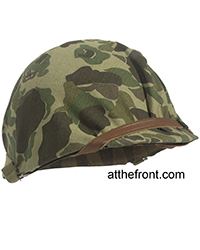
Up for sale is a late World War II / Korean War reissue United States Marine Corps M1 helmet complete with reversible camouflage cover. All in near mint condition!
The helmet itself is a late war (1944-45), rear seam swivel bail McCord with a '1018I' heat stamp and sewn-on chin strap.
The liner was made by Firestone and is marked with the Firestone 'F in a shield” and the number 29 on the inside of the dome. The webbing is all khaki colored which is typical of wartime liners and the A-washers are finished with phosphate which is typical of mid-late war liner hardware. The sweat band ink stamp is a little hard to read, but it is marked with typical factory serial numbers and “S.M.C. 1943.” The nape strap is also marked with factory serial numbers and “S.M.C. LARGE.” The leather chinstrap is in near perfect shape with the buckle being marked: UNITED CARR on the rear rivet and PAT 236872 on the latch. All components of the helmet and liner are near mint!
The camouflage cover on this helmet is commonly known as the “2nd Pattern USMC Helmet Cover” which first saw service in 1943. This type of helmet cover is typified by two rows of slits sewn into the fabric for the purpose of adding vegetation to camouflage the soldier. The cover is made of herring bone twill (HBT) woven cotton. One side is printed with a “beach” camouflage scheme, the other with a “jungle” camouflage scheme. This cover is devoid of any markings except for a USMC Eagle Globe and Anchor (EGA) ink stamp on the forehead of the “beach” side of the cover. The only issue with this whole set-up is that the camouflage cover has a field repair. This entire helmet and cover combo exhibits all the traits typical of a USMC helmet produced and used during the tail end of World War II and then reissued for the Korean War!
USMC helmets are increasingly rare and desirable. With the exception of the repair on the camouflage cover, this entire combo is near mint and will be hard to upgrade!
Asking $550 shipped. I also have a USMC HBT shirt in similar condition (a little more wear and some stains) that I’ll throw in to sweeten the deal.
Please do not hesitate to contact me with questions and/ or for additional photos. While I am primarily looking to sell this helmet, I am not totally opposed to trades. I love World War II firearms and militaria. Please do not be afraid to offer. The worst I can say is: 'No thanks!'
Thanks for taking a look!
| M1 helmet | |
|---|---|
Refurbished M1 helmet with liner and helmet cover shown | |
| Type | Combat helmet |
| Place of origin | United States of America |
| Service history | |
| In service | 1941–1985 (US Military) |
| Used by | See Users for details |
| Wars | World War II Korean War First Indochina War Vietnam War Cambodian Civil War Laotian Civil War Portuguese Colonial War Lebanese Civil War Falklands War United States invasion of Grenada Gulf War |
| Production history | |
| Designer | Major Harold G. Sydenham[1] |
| Manufacturer | McCord Radiator and Manufacturing Company and Schlueter Manufacturing Company[2] Ulbrichts Witwe |
| No. produced | 22 million (1945)[2] |
This WW2 US M1 helmet is a fixed bale, front seam helmet, as was issued to both US Army and USMC troops throughout most of the war. It has a nice original, WWII USMC camouflage helmet cover on it. 1959, Cover Helmet Camouflage, M-1 Helmet, Mitchell Pattern Cover, Steel Pot, USMC, Vietnam War Unexpected USMC Find I bought a helmet from a guy in Idaho and it arrived this afternoon.
The M1 helmet is a combat helmet that was used by the United States military from World War II until 1985, when it was succeeded by the PASGT helmet. For over forty years, the M1 was standard issue for the U.S. military. The M1 helmet has become an icon of the American military, with its design inspiring other militaries around the world.
The M1 helmet is extremely popular with militaria collectors, and helmets from the World War II period are generally more valuable than later models. Both World War II and Vietnam era helmets are becoming harder to find. Those with (original) rare or unusual markings or some kind of documented history tend to be more expensive. This is particularly true of paratroopers' helmets, which are variants known as the M1C helmet and M2 Helmets, which used special liners with multi-point retention straps to prevent undesired movement of the helmet during descent.
- 2Design
- 3Accessories
- 4Users

History[edit]
The M1 helmet was adopted in 1941 to replace the outdated M1917 A1 'Kelly' helmet[3] after research was done in the 1940s by Major Harold G. Sydenham.[1] Over 22 million U.S. M1 steel helmets were manufactured through September 1945, at the end of World War II.[4] Production was done by McCord Radiator and Manufacturing Company and Schlueter Manufacturing Company.[2]
A second US production run of approximately one million helmets was made in 1966–1967. These Vietnam War–era helmets were different from the World War II/Korean War version by having an improved chinstrap,[citation needed] and were painted a light olive green. The M1 was phased out during the 1980s in favor of the PASGT helmet,[5] which offered increased ergonomics and ballistic protection. No distinction in nomenclature existed between wartime front seams (so-called due to the location of the seam on the helmet's brim) and post war, or rear seam, shells in the United States Army supply system, hence World War II shells remained in use until the M1 was retired from service.[citation needed]
While obsolete in the United States, the M1 Helmet and international variants are still in use by other nations around the world.[citation needed] The M1 helmet liner still occupies a symbolic niche in the United States military. For example, liners are currently worn in training by United States Navy SEALs BUD/S candidates and labeled with the trainees' class number, name, and rank insignia, while painted and chrome-plated versions are still used in ceremonial units. In Israeli service, reserve soldiers have used the M1 helmet in combat as late as 2006.[citation needed]
Design[edit]
A soldier wearing a helmet with camouflage cover and additional natural camouflage added on the slots in the helmet's cover.
U.S. soldiers in 1972 wearing M1 helmets
The M1 is two 'one-size-fits-all' helmets—an outer metal shell, sometimes called the 'steel pot', and a hard hat–type liner that is nestled inside the shell and contains the suspension system that would be adjusted to fit the wearer's head. Helmet covers and netting would be applied by covering the steel shell with the extra material tucked inside the shell and secured by inserting the liner.
The outer shell should not be worn by itself. The liner can be worn by itself providing protection similar to a hard hat, and was often worn in such fashion by military policemen, Assistant Drill Instructors (known as AIs), and rifle/machine gun/pistol range staff, although they were supposed to wear steel at the range.[citation needed] The liner is sometimes worn in U.S. military ceremonies and parades, painted white or chromed.[citation needed] The depth of the helmet is 7 inches (180 mm), the width is 9.5 inches (240 mm), and length is 11 inches (280 mm), the thickness is 1/8' (3 mm), The weight of a World War II–era M1 is approximately 2.85 pounds (1.29 kg), including the liner and chinstrap.
Shell[edit]
The shell of the M1 was changed mainly in silhouette, as seen from the side, from its World War II beginnings.[citation needed] The second, and last, U.S. production run of about one million M1s during the mid 1960s, lowered (streamlined) the top forehead portion.[citation needed] The bulk of the helmet is constructed from a single piece of pressed hadfield manganese steel. The rim edge of the shell has a crimped metal band running around it, which provides a clean edge. This is usually known as the 'rim'. The metal band of the rim material has a seam where the ends of the strip meet. On the earliest shells the seam met at the front. This was moved to the back of the rim in November of 1943[6],[citation needed] when the rim went from being made of stainless steel to manganese steel.
On each side of the helmet there are stainless steel loops for the chinstrap. The shape of these fixtures is one of the most recognizable distinguishing factors between shells produced at different times. Early World War II production helmets had fixed, rectangular loops, and late-war and 1960s helmets feature movable rectangular loops which swiveled inward and outward. This swivel feature was adopted in 1943 to address the problem that when earlier helmets were dropped, the loops were more susceptible to breaking off. Early paratrooper shells feature fixed, D-shaped loops. World War II production helmets feature Olive Drab shade 3 chinstraps, replaced starting in 1944-45 with Olive Drab shade 7, cotton web chinstraps that are sewn on. 1960s and 1970s chinstraps are made of olive drab webbing attached to the shell with blackened metal clips. Nylon, clip-on, chinstraps were introduced in the U.S. military in the 1980s[citation needed]and issued to be fitted by the individual serviceman to his own helmet. These straps featured a two-piece web chin cup and were fastened by a metal snap rather than buckle.
Many soldiers wore the webbing chinstraps unfastened or looped around the back of the helmet and clipped together. This practice arose for two reasons: First, because hand-to-hand combat was anticipated, and an enemy could be expected to attack from behind, reach over the helmet, grab its visor, and pull. If the chinstrap were worn, the head would be snapped back, causing the victim to lose balance, and leave the throat and stomach exposed to a knife thrust. Secondly, many men incorrectly believed that a nearby exploding bomb or artillery shell could cause the chinstrap to break their neck when the helmet was caught in its concussive force, although a replacement buckle, the T-1 pressure-release buckle, was manufactured that allowed the chinstrap to release automatically should this occur. In place of the chinstrap, the nape strap inside the liner was counted on to provide sufficient contact to keep the helmet from easily falling off the wearer's head.[7]
The design of exterior metal led to some novel uses: When separated from the liner, the shell could be used as an entrenching tool, a hammer, washbasin, bucket, and as a seat. The shell was also used as a cooking pot but the practice was discouraged, as it would make the metal alloy brittle.[8]
Liner[edit]
The interior of a M1 Helmet Liner.
The liner is made from many parts. The outer part is shaped to fit snugly into the steel shell. The various elements of the suspension system are riveted, later clipped, inside it. The suspension is made from strips of webbing material stretching around and across the inside of the liner. A sweatband is mounted onto these, which is adjusted to fit around the head of the wearer. World War II and Korean War era liners also have their own chinstrap made from brown leather. The liner chinstrap is snapped or riveted directly to the inside of the liner and does not have bails like the shell chinstrap, but it still swivels inside the helmet. The liner chinstrap is usually seen looped over the brim of the shell and helps to keep the shell in place when its own chinstraps aren't in use.
The first liners were produced in June 1941 and designed by Hawley Products Company.[9] They were made from compressed paper fibers impregnated with phenolic resin, but were discontinued in November 1942. The original liners degraded quickly in high humidity environments and were eventually replaced by constantly evolving plastic liners.[9] These liners were produced by Hawley Products Company, and General Fibre Company, a subsidiary of International Hat Company.[9] The General Fibre liners are particularly rare, having been subcontracted by Hawley Products to the St. Louis-based firm at the end of 1941.[9] The McCord M1 shells of these 1941 helmets are stamped with an upper case 'G' to signify the liner was produced by General Fibre.[9]
In 1942, the original silver Rayon suspension material was phased out in favor of khaki cotton. There were many companies making liners during the war—Westinghouse Electric & Manufacturing Company made most of them, while other companies included The Firestone Tire and Rubber Company, CAPAC Manufacturing, Inland Division of General Motors, Mine Safety Appliances, Seaman Paper Company, and International Molded Plastics.
Liners nearly identical in construction to World War II examples were produced between 1951 and 1953 during the Korean War by the Micarta Division of Westinghouse and CAPAC Manufacturing. These liners differ in that color of the HBT webbing was changed from khaki or Olive Drab #3 to a darker green color known as Olive Drab #7. Much later, liners switched to using stronger synthetic webbing and had improved neck support.
In the 1960s, the M1 helmet liner was redesigned, eliminating the leather chin strap, nape strap and a change in the suspension webbing to a pattern resembling an asterisk in a coarse cotton web material in lieu of the earlier herringbone twill. In the early 1970s, materials changed to a thicker, more flexible nylon with a rougher unbeveled rim. Later changes included a move to a yellow and green material for liner construction.
Accessories[edit]
Cover[edit]
M1 Helmet Usmc Cover Size
Camouflage-patterned helmet covers of USMC during the Battle of Incheon, Korea, 1950.
Around late 1942 or early 1943, the United States Marine Corps used a cloth camouflage-patterned helmet cover for its helmets. The cover was made from herringbone twill fabric. It had a 'forest green' pattern on one side and a 'brown coral island' pattern on the other.[citation needed]
The United States Army often utilized nets to reduce the helmets' shine when wet and to allow burlap scrim or vegetation to be added for camouflage purposes. Most nets were acquired from British or Canadian Army stocks or cut from larger camouflage nets. The Army did not adopt an official issue net until the M-1944 mesh net that included a neoprene foliage band, which would have been retained on later Mitchell and woodland camouflage covers.[citation needed]
After World War II, various styles of camouflage cover were used at different times. In the 1960s through 1970s, the type commonly seen in the United States Army and Marine Corps was a reversible fabric cover called the Mitchell Pattern, with a leafy green pattern on one side and orange cloud pattern on the other. This type was nearly omnipresent in Vietnam, and where, for the first time, the army wore the cloth camouflage as general issue; whereas in World War II and the Korean War, the army traditionally wore their helmets only with nets, plain without anything on it, or with field-made, non-issue covers without camouflage. By contrast, United States Marines have consistently worn a cloth camouflage cover over their M-1 helmets in all three major wars—World War II, Korea, and Vietnam. The Korean War (1950–1953) was largely fought using World War II weapons and equipment, and the Marine Corps helmets and camouflage covers were basically the same as those used during World War II. In Vietnam, the green portion of the reversible fabric camouflage was normally worn outermost. Helmet covers in the (European) woodland camouflage, were designed for fighting in the European Theater of Operations (NATO), and became the post-Vietnam (jungle pattern) camouflage cover used by the U.S. military from the late 1970s onward. The (European) Woodland pattern was not reversible; they were only printed on one side, though some rare desert camouflage examples do exist. These covers were all constructed from two semi-circular pieces of cloth stitched together to form a dome-like shape conforming to the helmet's shape. They were secured to the helmet by folding their open ends into the steel pot, and then placing the liner inside, trapping the cloth between the pot and the liner. An olive green elastic band, intended to hold additional camouflage materials, was often worn around the helmet to further hold the cover in place.
Other armies used these or similar covers printed with different camouflage patterns, or employed entirely different methods. In the Dutch Army, for example, it was common practice to use a square piece of burlap as a helmet cover on M1 helmets, usually secured by a net (see above) and a wide rubber band.
During the Battle of the Bulge and Korean War, soldiers made white helmet covers as camouflage in snowy areas. They were not issued to soldiers, so many soldiers simply made them from a white cloth from a shirt or tablecloth.[citation needed]
Users[edit]
Current[edit]
- Colombia: Some M1s still in use by Military Police and ceremonial units.[10]
- Dominican Republic: Only used by Dominican military honor guard forces.[11]
- India: Made locally and are still in service.[12]
- Indonesia: Formerly used by former Indonesian Armed Forces,[citation needed] now in use by Indonesian Police.[citation needed]
- Iran: Uses the West German-made M1s.[13]
- Guatemala: Used only in the Guatemalan Army and Navy.[14]
- Japan: Uses the Type 66 helmet, modeled after the M1 helmet that was supplied to the JSDF. Currently used in non-combat operations.[15][16] Formerly used M1s supplied by the US to the JSDF before the adoption of the Type 66.[17]
- Panama: Formerly used by former Panamanian military, now in use by Panamanian Public Forces.[18]
- South Africa[citation needed]
- South Korea: Uses M1 style ballistic helmets made by Silver Star.[19]
- Thailand[citation needed]
- Uruguay: Used South Korean-made M1s with some still in use.[20]
- Vietnam[citation needed]
Former[edit]
Chinese army soldiers with M1 helmets during the Second Sino-Japanese War.
- Argentina: Used by the Argentine military before they were replaced.[21]
- Australia: Australian Defence Force previously used Australian and American-made M1s from the 1960s to the 1990s. Replaced by the Australian-made M91 PASGT helmet in the 1990s.[22]
- Austria: Used by the Austrian Army after it was reformed in 1955 with 30,000 M1s supplied by the US.[23] Copies made in 1958 known as Stahlhelm 2 (M.58) with another made in the 1970s with a German-made helmet suspension, all made by Ulbrichts Witwe.[23]
- Belgium: Used Ulbrirchts-made M1 helmets.[23]
- Brazil: Previously used American and Brazilian M1s for the military.[24]
- Bolivia: Used American, Brazilian and Korean-made M1s before being removed from service.[25]
- Canada: Replaced by the CG 634 helmet.[26]
- Chile: Formerly used by the Chilean military with liners made by Baselli Hnos.[27]
- China, Republic of: Used in the Second Sino-Japanese War and in the Chinese Civil War and in Taiwan until the 1990s.[28]
- Costa Rica: Formerly used American-made M1 helmets.[29]
- Cuba: Used in Cuban military until Bastista was deposed, replaced by Warsaw Pact-made helmets.[30]
- Denmark: Used Ulbrirchts-made M1 helmets under the designation of Staalhjelm model 48 (m/48).[23]
- Ecuador: Formerly in use by the Ecuadorian military.[31]
- El Salvador: Provided by the US in the 1970s as part of military aid, now replaced by PASGT.[32]
- Greece: Adopted by the Greek Army in 1952.[33]
- Haiti: Used by former Haitian military.[34]
- Honduras: Formerly used by Honduran military after signing the Rio Treaty.[35]
- Iran: Formerly used by the Imperial Iranian Army.[36]
- Iran: Formerly used by the Islamic Iranian Army, but it turns up from time to time.[36]
- Israel: Formerly used by the Israeli military, supplied by Britain, France and the United States.[37] Some M1s used have a combination of American and Israeli parts.[38]
- Lebanon: Used American-made M1s.[citation needed]
- Mexico: Formerly used by the Mexican military.[39]
- New Zealand: Used by the New Zealand Army from the 1960s all the way to 2000s, mostly using American and South Korean-made M1s.[40]
- Netherlands: Used Ulbrirchts-made M1 helmets.[23]
- Nicaragua: The Guardia Nacional de Nicaragua used M1 helmets supplied by the United States 1954-1979.[41]
- Norway: Used Ulbrirchts-made M1 helmets.[23]
- Paraguay: Adopted the M1 after signing the Rio Treaty.[42]
- Peru: Formerly used M1 helmets supplied by the US.[43] Some obtained from Israel and West Germany.[44]
- Philippines: Formerly used M1 helmet in the Armed Forces of the Philippines.[45] Some reserve stocks for training of the recruits.[citation needed]
- Saudi Arabia: Formerly used M1 helmets supplied via South Korea and Taiwan.[46]
- Singapore: Formerly used by the Singaporean military from the late 1950s with inner liners made locally. Used up until the mid-1980s, when they began to be gradually replaced, and finally phased out, by a similar helmet to the US PASGT helmet, in the 1990s.[47]
- Spain: Used M1s made from America and Europe, modified for marine and paratrooper forces.[23]
- South Vietnam: The standard helmet of the South Vietnamese military from 1955 up until the fall of the country to North Vietnam in 1975, all throughout the Vietnam War.[citation needed]
- PRC: Used captured M1 helmets from the Chinese Nationalist Army during the Chinese Civil War.[citation needed] Extremely few, if any, saw service beyond that conflict.[citation needed]
- Turkey: Used by the Turkish military, most made locally.[48]
- United States: Formerly used by the United States Air Force as the M3 and later, the M5, helmet for flak protection.[49] Formerly used by the US military from the 1940s to the 80s, replaced by the PASGT.[50]
- Venezuela: Used by the Venezuelan military, now replaced.[51] Majority made in the US and South Korea.[52]
- West Germany: Formerly used by the West German army, helmets made by F. W. Quist Company.[53]
See also[edit]
References[edit]
- ^ ab'M-1 Steel Helmet'.
- ^ abcCOMBAT-HELMETS. 'Schlueter Vs McCord'. nuke.combat-helmets.com.
- ^'M1917 A1 Helmets'. US Militaria Forum. Retrieved July 12, 2016.
- ^Stanton, Shelby L., U.S. Army Uniforms of World War II, Stackpole Books, 1995, ISBN0-8117-2595-2, url:[1], pp. 57–58
- ^Hartzog, William W., American Military Heritage, url:[2], p. 224
- ^'Dating the M1 Steel Helmet'. www.hardscrabblefarm.com. Retrieved 2019-05-05.
- ^Tagliavini, Michele. 'STAGE AND SCREEN In all those Hollywood war films, and in quite a few newsreels, the GIs wear helmets but never fasten the straps. Is this bravado, bad discipline or artistic licence?'. The Guardian. London. Retrieved 8 March 2013.
- ^Pike, John. 'M1 Steel Combat Helmet and Liner'. GlobalSecurity.org. GlobalSecurity.org. Retrieved 8 March 2013.
- ^ abcdeGiard, Regis (2008). Helmets of ETO: A Historical and Technical Guide. Havertown, PA: Casemate Publishers. p. 12. ISBN9782352500629.
- ^'Colombia'.
- ^'Dominican Republic'.
- ^'India M1'. Brendon's Helmets.
- ^http://brendonshelmets.weebly.com/iran-m62.html
- ^'Guatemala'.
- ^Ministry of Defense (Japan) (2014-04-23). 'Ministry of Defense specification sheet, LINER, GROUND TROOPS' HELMET'(PDF) (in Japanese).
- ^Ministry of Defense (Japan) (2014-03-28). 'Ground Self-Defense Forces Dress Manual'(PDF) (in Japanese).
- ^66式 鉄帽. rightwing.sakura.ne.jp (in Japanese).
- ^'Panama'.
- ^'Composite Helmet, Ballistic helmets, Military helmets KOREA, SOUTH KOREAN HELMET helmet, Kevlar helmet'. www.gostak.co.uk.
- ^'Uruguay'.
- ^'Argentina'.
- ^'US Camouflaged Helmet Cover : South Vietnam'. Australian War Memorial.
- ^ abcdefg''Euroclones' - An essentiel collector's guide'. OCAD Militaria Collectors Resources.
- ^'Brazil'.
- ^'Bolivia'.
- ^http://www.mpmuseum.org/securhelmet.html
- ^'Chile M1'. Brendon's Helmets.
- ^'Taiwan M1'. Brendon's Helmets.
- ^'Costa Rica'.
- ^'Cuba'.
- ^'Ecuador'.
- ^'El Salvador'.
- ^'Greek M1'. Brendon's Helmets.
- ^'Haiti'.
- ^'Honduras'.
- ^ abhttps://wwiiafterwwii.wordpress.com/2016/10/16/wwii-weapons-in-the-ayatollahs-iran/
- ^'Israel M1'. Brendon's Helmets.
- ^'Israeli M1 steel helmet Yom Kippur War 1973 - Collectors Weekly'. www.collectorsweekly.com.
- ^'Mexico M1'. Brendon's Helmets.
- ^'New Zealand M1'. Brendon's Helmets.
- ^'Nicaragua'.
- ^'Paraguay'.
- ^'Peru M1'. Brendon's Helmets.
- ^'Peru'.
- ^'Phil. Marines PASGT helmet'. www.oocities.org.
- ^'Saudi M1'. Brendon's Helmets.
- ^'Singapore M1'. Brendon's Helmets.
- ^'Turkey M1 Airborne'. Brendon's Helmets.
- ^http://www.alliedflightgear.com/USAAF%20flak%20helmets.html
- ^Webster, Donovan. 'How the Military Helmet Evolved From a Hazard to a Bullet Shield'.
- ^'Venezuela M1'. Brendon's Helmets.
- ^'Venezuela'.
- ^'West Germany M1'. Brendon's Helmets.
- Armold, Chris (1997). Steel pots: the history of America's steel combat helmets (1st ed.). San Jose, Calif: R.James Bender Pub. ISBN091213870X.
- Oosterman, Pieter (2010). The M-1 helmet of the World War II GI: a reference based on the M-1Helmet.com collection. Atglen, PA: Schiffer Publishing. ISBN9780764336638.
- Giard, Régis; Blais, Frederic (2007). Helmets of ETO: a historical and technical guide. Paris, France : Histoire & Collections. ISBN9782352500629.
- Reynosa, Mark A. (1996). The M-1 helmet: a history of the U.S. M-1 helmet in World War II. Atglen, PA: Schiffer Publishing. ISBN0764300741.
- Reynosa, Mark A. (1999). Post- World War II M-1 helmets: an illustrated study. Atglen, PA: Schiffer Publishing. ISBN076431033X.
External links[edit]
| Wikimedia Commons has media related to M1 helmets. |
- 'steel helmet, pattern M1, with liner, US Army'. Ukniwm.org.uk. Retrieved 7 December 2017.
- 'Steel Helmet, 'Talker' MKII: US Navy'. Ukniwm.org.uk. Retrieved 7 December 2017.
Retrieved from 'https://en.wikipedia.org/w/index.php?title=M1_helmet&oldid=902509745'
Coments are closed
© 2019 - nowbotstorm